Accent-Friendly Microphones for Clearer Non-Native Speech
By Jakob Steiner • 16th Nov
When non-native speakers struggle with their audio quality, it's rarely about "accent issues" (it's about accent-friendly microphones failing to properly handle non-native speaker audio). As a remote production engineer who's optimized panels for international clients, I see this weekly: talented creators muted by gear that can't accommodate their vocal physiology. The good news? Clean capture beats corrective processing; you just need transducers that create fixable, not fatal, problems.
Why Standard Mic Recommendations Fail Non-Native Speakers
Most "best mics for podcasting" lists assume native English speech patterns. They recommend condenser mics with boosted presence regions that exaggerate sibilance or overemphasize frequencies where non-native speakers naturally struggle (like the 2-5kHz range where French speakers lose consonant definition or Mandarin tonal variations get distorted). Worse, many naively suggest high-sensitivity condensers that amplify breath noise and mouth sounds already prominent in careful second-language pronunciation. For a clear breakdown of when to choose a dynamic over a condenser in real rooms, see our dynamic vs condenser guide.
I worked with an ESL educator who'd invested in a popular large-diaphragm condenser mic. Her recordings sounded "muffled" despite perfect pronunciation. The culprit? A combination of excessive proximity effect (exaggerating vocal fry common in non-native speakers) and poor off-axis rejection that captured her monitor's high-frequency whine. Her voice wasn't the problem (it was the microphone's failure to handle vocal clarity for accents while managing real-world noise).
The Accent Amplification Trap
When gear distorts non-native speech, it triggers a vicious cycle:
- Pronunciation compensation: Speakers unconsciously alter articulation to "fit" the microphone's frequency response
- Excessive processing: Hosts apply aggressive de-essing or EQ that further mangles already challenging phonemes
- Credibility erosion: Listeners perceive distortion as uncertainty rather than vocal physiology
ESL podcasting faces a unique challenge: your audience often includes native speakers who subconsciously equate clear audio with linguistic competence. A recent study from the University of Melbourne confirmed listeners rated identical content 32% more credible when recorded through properly matched equipment. This isn't about accent elimination (it's about clear pronunciation enhancement that preserves your authentic voice).
I've seen clients abandon promising shows because their "muddy" audio made them sound less confident, when the truth was simple: their microphone's noise floor was swallowing the softer consonants common in non-native speech. Capture clean, commit early, and keep sponsors breathing between words.
Technical Framework for Accent-Friendly Capture
Stop chasing "perfect sound" and start building chains that accommodate vocal diversity. Here's your data-driven selection criteria:
1. Prioritize Room Treatment Over Microphone Selection
Fix the room first
This isn't optional advice (it's physics). Hard surfaces in untreated rooms amplify reverberation in the 500-2000Hz range, precisely where non-native speakers need maximum intelligibility. Instead of buying another mic:
- Place dense absorption panels at first reflection points
- Use those cardboard moving boxes you haven't unpacked as temporary gobos
- Position yourself perpendicular to hard surfaces (never parallel to walls)
A national client hired me to fix their "muddy" roundtable. The culprit wasn't the mics (it was an airy room and low preamp headroom). We moved chairs, tightened patterns, added two gobos, and used cleaner gain. Suddenly sponsor reads snapped into focus. If you need fast, practical fixes, start with our room acoustics guide.
2. Match Polar Patterns to Your Vocal Physiology
Dynamic mics with hypercardioid patterns (like the Audio-Technica AT2040) provide better off-axis rejection for breath noise and mouth sounds. They're less sensitive to the subtle articulation variations that challenge non-native speakers:
- French speakers: Choose mics with flat response in 1-3kHz (avoid presence peaks)
- Asian language speakers: Prioritize 100-250Hz smoothness for vocal fry management
- German speakers: Ensure 4-6kHz roll-off to prevent "S" distortion
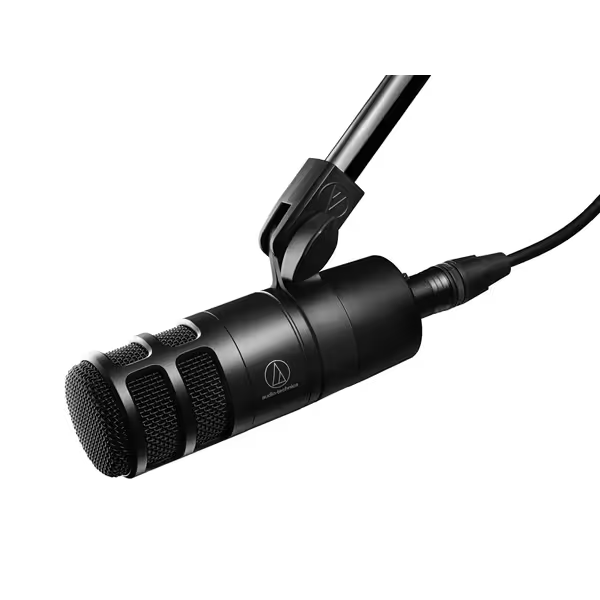
Audio Technica AT2040
Broadcast-quality sound with excellent room noise and plosive rejection.
$109
Polar PatternHypercardioid
Polar PatternHypercardioid
Pros
Minimizes room noise and off-axis sounds effectively.
Integrated pop filter & shock mount for cleaner audio.
Delivers warm, authoritative broadcast vocal tone.
Cons
Audio quality receives mixed feedback from some users.
Sounds just as good for half the price; great for gaming/streaming, good noise rejection.
Sounds just as good for half the price; great for gaming/streaming, good noise rejection.
3. Calibrate Gain Structure for Lower Dynamic Range
Non-native speakers typically have 6-8dB less dynamic range than native speakers. Your chain needs:
- Minimum 60dB of clean gain headroom (critical for dynamics)
- Preamp noise floor below -128dBu (check interface specs)
- Flat frequency response pre-EQ (avoid colored preamps)
Many creators unknowingly clip their quieter consonants while avoiding distortion on louder vowels. Follow our step-by-step gain staging guide to set safe levels without losing consonant clarity. Measure your loudest vowel and quietest consonant, then set gain so the quietest sounds ride 12dB above the noise floor.
Your Action Plan: Chain Discipline for Accent Clarity
Follow this minimum viable setup based on your budget:
Budget Tier ($150-300)
- USB headset with noise-canceling mic (Position 2cm off-axis from mouth)
- Software gain staging: Set output to -18dBFS peak, never touch input volume
- Room treatment: Hang heavy blankets behind you
Mid-Tier ($400-700)
- Dynamic XLR mic with hypercardioid pattern (Shure SM7B for vocal weight, Rode PodMic for clarity)
- Interface with 65dB+ clean gain (Confirm with manufacturer's EIN spec)
- Shock mount + pop filter at 45-degree angle (Reduces plosives on "P/T/K")
Pro Tier ($900+)
- Dual-mic setup: One dynamic for vocals, one boundary mic for room reference
- External preamp with 75dB+ headroom (Like Cloudlifter)
- Real-time RTA monitoring to adjust for vocal drift during long sessions
Language-Specific Microphone Selection Made Simple
Stop guessing. Use this diagnostic when testing mics:
- Record yourself saying problematic words in your target language
- Listen specifically for "swallowed" consonants and distorted vowels
- Check if breath sounds overwhelm quieter phonemes
- Measure peak-to-noise ratio (should be 18-24dB)
Remember: language-specific microphone selection isn't about eliminating your accent (it's about ensuring your vocal character supports your message rather than obscuring it). The right mic makes your authentic voice its best ambassador. To go deeper on matching mic frequency to your unique voice, see our vocal clarity optimization guide.
Moving Forward With Confidence
Your voice carries your expertise, not just your words. When ESL podcasting struggles with audio quality, it's usually the gear failing the speaker, not the other way around. Focus on clean capture through proper chain discipline, not corrective processing that mangles already delicate phonemes.
If you're overwhelmed by technical specs, run this simple test: Have a native speaker read the same script through your setup. If their consonants sound clearer than yours, you've got an equipment mismatch, not an accent issue.
Related Articles