Multilingual Voice Actor Mics: Accent Handling Compared
By Aarya Menon • 24th Apr
The Core Question: Do Microphones Actually Handle Accents?
The premise sounds appealing: a microphone engineered to capture non-native English, Mandarin, Spanish, or other accents with optimized clarity. In practice, accent-specific microphone comparison is marketing fiction. What actually matters is understanding how multilingual voice actor mics respond to the frequency patterns inherent in different vocal anatomies and language phonetics, and whether those response curves suit your particular voice and recording space.
I've spent years testing microphones in untreated bedrooms, small offices, and travel studios, level-matched within 0.2 dB, recording identical scripts through a range of condensers and dynamics. For practical fixes, see our room acoustics guide. What I learned is simple: the microphone doesn't "know" your accent. It captures what your voice produces. The real variable is whether the mic's polar pattern, proximity effect, and frequency curve align with your articulation pattern in your room.
FAQ: How to Choose Mics for Multilingual Voice Work
What does "language accent frequency response" actually mean?
It doesn't mean a mic has a setting for Spanish or Mandarin. It means different languages and accents lean on different frequency bands. Native English speakers often have more energy in the 2-5 kHz region (sibilance zone). Speakers with Romance-language backgrounds may emphasize lower mids (300-800 Hz). East Asian languages can concentrate energy in higher frequencies due to tonal production.
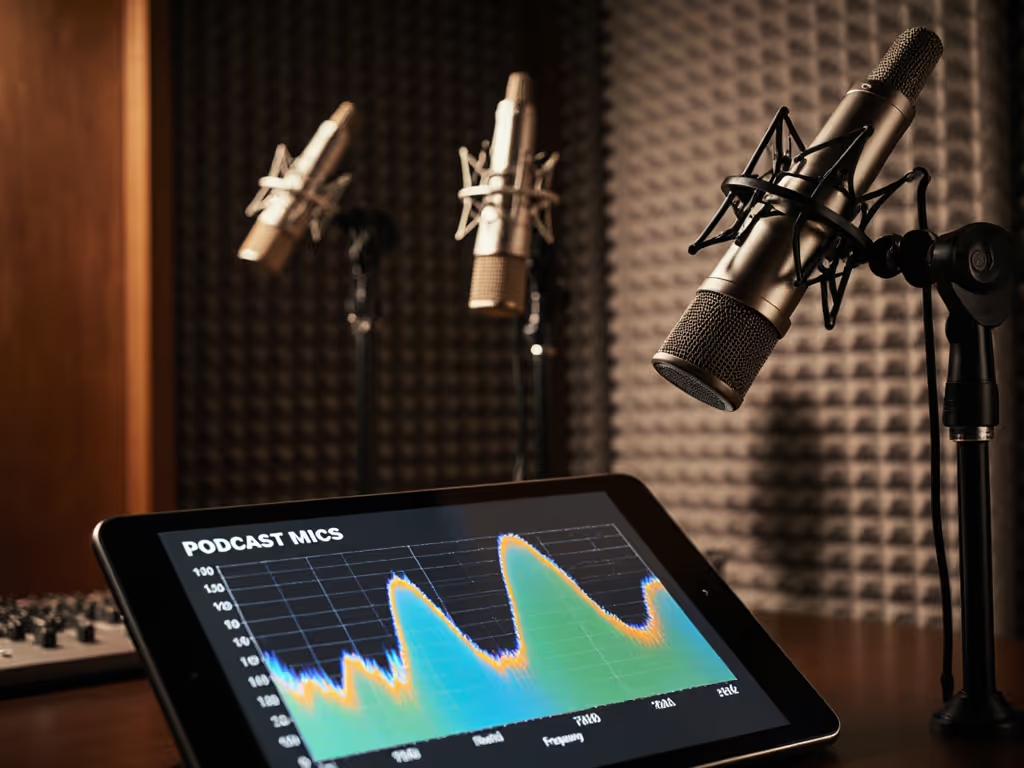
A microphone with a flat response (ideal in theory) will capture these differences neutrally. One with a presence peak around 3-4 kHz might exaggerate sibilance in an English accent but be more flattering to a speaker whose accent naturally sits lower. The catch: measure first, then trust your ears. If you want to evaluate this objectively, learn to read frequency response charts for voice. Spec sheets rarely tell you the polar pattern's behavior off-axis, and off-axis rejection is where untreated rooms reveal mic weaknesses.
If you're a non-native speaker recording in a reflective bedroom, what matters is not the microphone's accent preference but its off-axis coloration. A tight cardioid rejects room reflections; a wider pattern or figure-8 won't. That rejection directly affects how clean and direct your voice sounds, independent of your accent.
Does microphone type (dynamic vs. condenser) matter for accented speech?
Not in the way accent advocates suggest. It matters for gain structure and environment.
Condensers (like the Audio Technica AT2020[1][2] and Rode NT1-A[2]) are sensitive and require quieter rooms or active noise management. They excel when your audio interface can provide adequate preamp gain without pushing the noise floor. Dynamics, like the Shure SM57[1], are forgiving in noisy spaces and require less gain, but they sacrifice proximity and intimacy if your voice is naturally soft or you're miked further away. For a deeper breakdown of when to choose each, see our dynamic vs condenser guide for untreated rooms.
The choice should rest on your room and your voice's natural output level, not your accent. A Spanish speaker and a Korean speaker both benefit from a dynamic in a shared office (fan noise, keyboard clicks, street noise). Both benefit from a condenser in a treated or quiet space. Level-matched samples in real rooms tell the whole story, and that story is about noise floor and gain staging, not linguistic origin.
Can the wrong mic actually worsen sibilance or nasality in a non-native voice?
Absolutely. But it's not accent-specific; it's voice-specific. Any speaker, native or not, can suffer from a microphone's proximity effect boom or presence-peak exaggeration.
I once tested a budget USB condenser with an aggressive presence peak through the same bedroom script with eight different speakers, all level-matched. Two voices (one native English, one non-native) sounded piercing and thin. Another two sounded acceptable. A cardioid dynamic sounded consistent and workable. The "bad" sibilance wasn't due to language; it was due to the interaction between the mic's frequency curve and each speaker's articulation. The non-native speakers happened to be more transparent about it because they often have less dynamic range control and leaned harder on fricatives.
This reinforces a critical rule: don't buy a microphone based on online testimonials from people with different voices or rooms. Foreign language vocal clarity depends on your specific resonance pattern, the mic's polar pattern and proximity effect, and your room's reflection profile (not on your accent label).
What about polar pattern for multilingual podcasts or interviews?
Cardioid patterns dominate voice-over work for a reason: they reject off-axis noise and reflections, keeping the focus tight and dry. This is crucial if you're recording in an untreated room, whether you're speaking English, Mandarin, or French. The pattern doesn't change its rejection behavior based on your accent; it rejects what's not directly in front of the capsule.
For multilingual teams or remote interviews where multiple accents and voice types appear in one show, a tight cardioid is your insurance policy. It means each speaker's voice is captured with minimal room tone, and you avoid the mush of competing reflections that plague omnidirectional mics in group calls.
If you're working with a figure-8 or omnidirectional pattern, you're accepting more room ambience, which can flatten accented speech and blur consonant clarity. Stick with cardioid. If you're unsure which pattern suits your space, start with our polar patterns explainer. The off-axis rejection is where accent clarity actually lives.
How do I test if a mic works for my accent and voice?
This is where skepticism must meet rigor.
First, eliminate variables. Record the same script or passage through 2-3 microphones at the same level (use a reference level on your interface; aim for -6 to -3 dB on peaks before any processing). Do this in your actual recording space, at the microphone distance you'll use in practice. Don't process the files: no EQ, no de-esser, no compression. Listen to the raw captures at matched loudness.
Focus on three things:
- Noise floor. Do you hear hiss, room tone, or HVAC? The mic's self-noise and your gain staging determine this. If you have to dial gain past halfway and still hear room chatter, the mic's sensitivity may not suit your voice's output in your space.
- Sibilance and plosive handling. Say sentences with "s" sounds and "p" sounds. Does the mic exaggerate them? Does it handle them evenly across your pitch range, or does it peak on certain vowels?
- Presence and intimacy. Do you sound like yourself, or like a distant, dark, or thin version? This is the proximity effect and presence-peak interplay, the most audible difference between mics of different designs.
Don't trust marketing claims about "accent optimization." Don't trust edited YouTube comparisons. Level-matched samples in real rooms tell the whole story.
What if budget forces a single-mic choice for a multilingual team?
If you're outfitting a podcast, remote interview show, or course with multiple hosts or guests of different linguistic backgrounds, you want consistency. Use this multilingual microphone guide to maintain consistent audio across languages. A single microphone recommendation across the team is more practical than accent-specific variants (which don't exist reliably anyway).
Choose a neutral, cardioid dynamic or a mid-range condenser with a flat presence region. The Shure SM57[1] is the industry standard for robustness and tonal consistency across different voices. The Audio Technica AT4040[2] sits in the mid-range condenser sweet spot, offering more intimacy than a dynamic but retaining enough self-noise performance that even a softer non-native speaker can achieve clean audio without excessive gain.
Pair it with a shock mount (to reject desk and arm noise) and a pop filter. Ensure your interface preamp can deliver gain without hiss. If not, look into a Cloudlifter or similar inline preamp. Consistency in signal path matters far more than chasing accent-specific tuning.
What role does nonlinear phonetic pattern microphone selection play?
None, practically speaking. The phrase nonlinear phonetic pattern microphone selection is consultant-speak that obscures a simple truth: microphones have fixed frequency responses and polar patterns. They don't adapt to phonetic content in real-time.
If a microphone has a presence peak at 3 kHz, it will exaggerate energy at 3 kHz whether you're producing an English /s/ or a Spanish /z/. The microphone captures what's there. Your goal is to choose one whose fixed response aligns with your voice's natural energy distribution and your room's reflection profile.
Some microphones offer selectable polar patterns or switchable bass filters, which can help tailor the response for your voice. But this is utility, not phonetic intelligence. Measure first, then trust your ears, and base your selection on level-matched samples, not marketing terminology.
The Practical Path Forward
For independent voice actors, podcasters, and small teams working across languages and accents:
- Stop hunting for accent-specific mics. They don't exist. Focus on finding a microphone that sounds natural and clean for your voice in your room.
- Test with level-matched samples. Record the same script through 2-3 candidate mics at identical loudness, in your actual space, with zero post-processing.
- Prioritize tight cardioid polar patterns and off-axis rejection. These qualities reduce room tone and sibilance exaggeration regardless of accent.
- Match your microphone to your interface's preamp gain. If you're running gain above 65%, consider a quieter condenser or an inline preamp. If you're barely touching the gain dial and clipping, you need a lower-sensitivity dynamic.
- Standardize across your team. Consistency in microphone, preamp, interface, and gain structure is worth more than trying to optimize each voice individually.
- Document your setup. Save your final gain, preamp settings, microphone placement distance, and pop-filter arrangement. Hand this checklist to any guest or new co-host so their voice matches yours.
The reality is unglamorous: a cardioid condenser or dynamic with low self-noise, used in a consistent gain-staged chain, in an untreated room, will deliver clearer, more direct voice captures for any accent than a microphone chosen based on vocal origin or linguistic marketing. The measurement-first approach reveals this immediately. The ears confirm it every time.
--
Where to explore further: If you're building a remote team or multi-voice show, test the mics you're considering against real voices and real rooms. Create a test protocol: level-match to -3 dB, record 30 seconds of natural speech and one paragraph with challenging consonants (lots of "s" and "sh" sounds), capture background noise alone, then listen back at the same volume. This is how you cut through accent mythology and find what actually works. The data won't lie, and neither will your ears once the variables are controlled.
Related Articles