Consistent Podcast Audio Across Languages: Microphone Guide
By Nora Adeyemi • 8th Nov
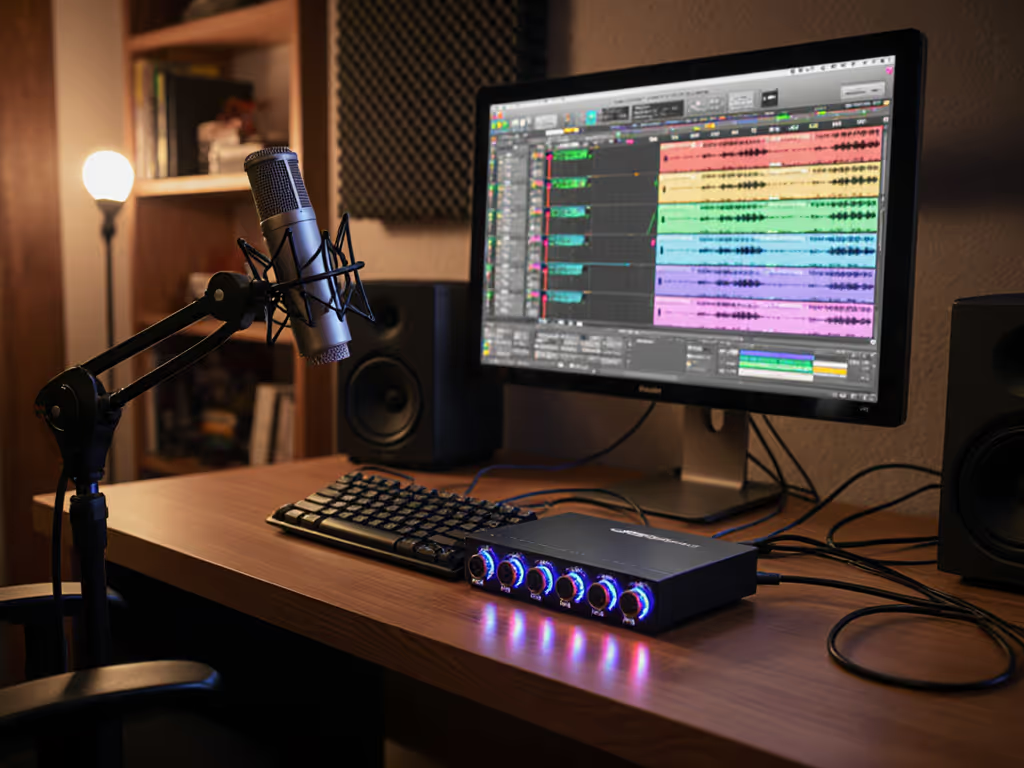
When recording podcast microphone setups for multiple languages, the biggest hurdle isn't equipment, it's achieving cross-language audio consistency. Your Spanish vowels might boom while your English consonants clip. Mandarin tones get lost in room echo. This guide cuts through the noise with beginner-friendly fixes that work now, without hours of editing. Forget chasing "perfect" waves; let's build green lights, not perfect waves (a repeatable setup where your voice sounds clean across every language you speak).
Why Your Audio Changes Between Languages (And What Mic Technique Fixes It)
Languages live in different parts of your vocal tract. French nasal vowels excite chest resonance differently than sharp Korean plosives. Many hosts panic when their "same" mic suddenly adds boominess in Portuguese or tininess in Japanese. Here's what's really happening:
- Language-specific frequency response shifts: Vowel-heavy languages (like Italian) emphasize 100-250Hz, triggering proximity effect. Consonant-rich languages (like German) highlight 5-8kHz, worsening sibilance.
- Mouth movement variance: Speaking Mandarin requires wider jaw opening than English, subtly changing mic distance as you talk.
The Fist-Width Fix (No Measuring Tape Needed)
Stop replaying takes because your Spanish sounds muffled. Lock consistent distance with this:
- Close your hand into a loose fist.
- Place it vertically between your mouth and mic.
- Aim the mic slightly off-axis (30 degrees away from your mouth). For step-by-step angles and distance techniques, see our podcast mic positioning guide.
This creates zero-post audio by:
- Preventing proximity boom on rounded vowels
- Reducing plosives on explosive consonants
- Maintaining identical distance whether you're speaking English or Arabic
Pro tip: Say "papa" in your native language. If your fist wobbles from breath, tilt the mic 5 degrees more off-axis.
Microphone Selection Made Simple for Multilingual Recording
"But which mic handles all languages?" Stop overcomplicating it. For beginners, consistent audio across languages starts with forgiving gear, not "studio-grade" specs. Here's what matters:
USB Over Hype: Why I Recommend Dynamic Mics
Condenser mics (like the Blue Yeti) capture everything: your room's echo, AC hum, and every "s" in Spanish. Dynamic mics (like the Samson Q2U) naturally:
- Reject background noise in untreated rooms
- Smooth out harsh consonants
- Handle volume spikes from emotional language shifts
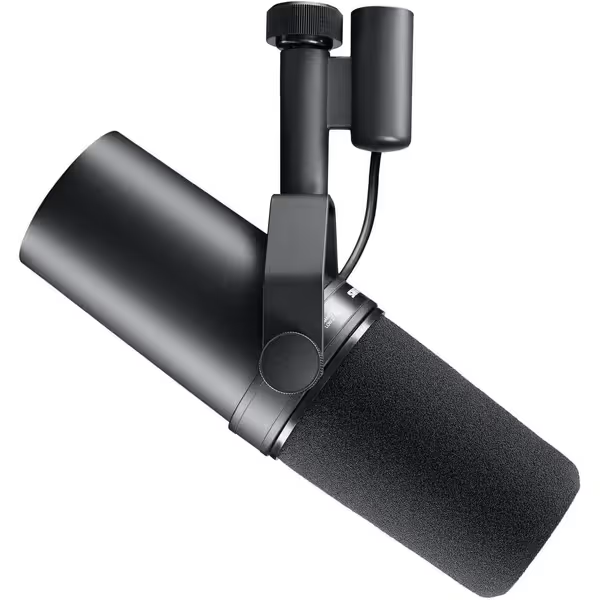
Shure SM7B Microphone
Achieve broadcast-quality vocals with superior noise rejection, even in untreated rooms.
$439
ConnectivityXLR
ConnectivityXLR
Pros
Broadcast-quality sound; warm, natural speech reproduction.
Exceptional rejection of room noise, hum, and plosives.
Rugged build for long-lasting, reliable performance.
Cons
Requires significant gain; may need an inline preamp.
Customers find this microphone to be a solid mid-grade option that delivers crystal clear sound with added richness in the bass and handles different vocal ranges exceptionally well. They appreciate its build quality, with one customer noting its all-metal construction, and consider it well worth the money. The functionality and noise level receive mixed feedback - while some say it works great, others report it doesn't work at all, and while some find it very forgiving of background noise, others mention a loud hiss with the preamp activated. The gain level also gets mixed reviews, with some finding it sufficient while others say it needs quite a boost.
Customers find this microphone to be a solid mid-grade option that delivers crystal clear sound with added richness in the bass and handles different vocal ranges exceptionally well. They appreciate its build quality, with one customer noting its all-metal construction, and consider it well worth the money. The functionality and noise level receive mixed feedback - while some say it works great, others report it doesn't work at all, and while some find it very forgiving of background noise, others mention a loud hiss with the preamp activated. The gain level also gets mixed reviews, with some finding it sufficient while others say it needs quite a boost.
Critical Feature Checklist
| Feature | Why It Matters for Multilingual Work | Beginner-Friendly Option |
|---|---|---|
| Direct Monitoring | Hear real-time audio without latency. Catch mouth clicks before editing. | Samson Q2U (instant headphone mix) |
| Adjustable Gain Knob | Compensate for louder/quieter languages without software. | PreSonus Revelator (physical dial) |
| Built-in Pop Filter | Softens plosives on languages heavy in "p," "b," "t" sounds. | Rode Podcaster (internal foam) |
Avoid polar pattern confusion: Cardioid (heart-shaped pickup) is all beginners need. It focuses on your voice while ignoring room noise, critical when switching between languages in the same space.
Room Setup Secrets for Language-Agnostic Clarity
Your bedroom won't become Abbey Road. Accept it. Instead, use minimal treatment to tame language-specific issues:
Quick Wins for Problem Frequencies
- For vowel-heavy languages (French, Italian): Drape a thick blanket behind your chair. It absorbs low-frequency boom without killing intimacy.
- For sibilant languages (English, Spanish): Angle your desk so windows/doors aren't directly behind you. Hard surfaces reflect harsh "s" sounds.
- Universal move: Record facing a closet full of clothes. Fabric absorbs mid/high frequencies that get exaggerated in post.
The 60-Second Room Test
- Play pink noise (use YouTube) at moderate volume.
- Walk around your space while speaking your target language.
- Where does your voice sound clearest? That's your recording spot, not where your desk is.
This beats spec-sheet paralysis. Real rooms, real voices. For bigger improvements with minimal gear, check our room acoustics for podcasting guide.
Monitoring Mistakes That Sabotage Multilingual Recordings
"Why does my German sound muddy?" Usually because you're not hearing it live. Direct monitoring solves this:
- USB mics: Plug headphones directly into the mic. Adjust the gain knob until your loudest phrase (e.g., shouting "¡Hola!") stays below -6dB. To set levels precisely across languages, follow our podcast mic gain staging guide.
- No software delay: What you hear is what you get. No guessing if plosives are fixed.
Critical step: Set levels after speaking 30 seconds in each language. Your singing voice might need -12dB gain, but your podcast voice sits at -8dB.
I watched a first-time host clutch a mic like an ice cream cone, peaking every laugh. We set a pop filter, angled slightly off-axis, locked distance with a fist-width trick, and enabled direct monitoring. Her next take was clean, her shoulders dropped, and the story finally breathed. Small, repeatable wins turn scary red lights into green.
Your Action Plan: Achieve Audio Consistency in 5 Minutes
Stop editing out "language wobble." Implement these today:
- Set your mic height so the capsule aligns with your upper lip (not chin). This keeps vocal distance identical whether you're speaking softly in Japanese or loudly in Russian.
- Enable direct monitoring and adjust the gain knob until your "ahhh" vowel hits -12dB. Verify with a plosive-heavy phrase like "Pepsi pass!" in Spanish.
- Record 20 seconds in each language you use. Play back immediately through headphones. If one language booms, move the mic 1 inch farther back, don't touch EQ.
Consistency isn't about expensive gear. It's about a repeatable setup that works whether you're recording in Swahili or Swedish. When your audio stops fighting you, something magical happens: You forget the mic exists. Your stories breathe. And listeners lean in, not because of pristine waves, but because you finally sound like you own the room.
Your Next Step: Tomorrow, before hitting record, do the fist-width check + direct monitoring test in your target language. Notice how much less you edit. That's confidence, built mic by mic, word by word.
Related Articles